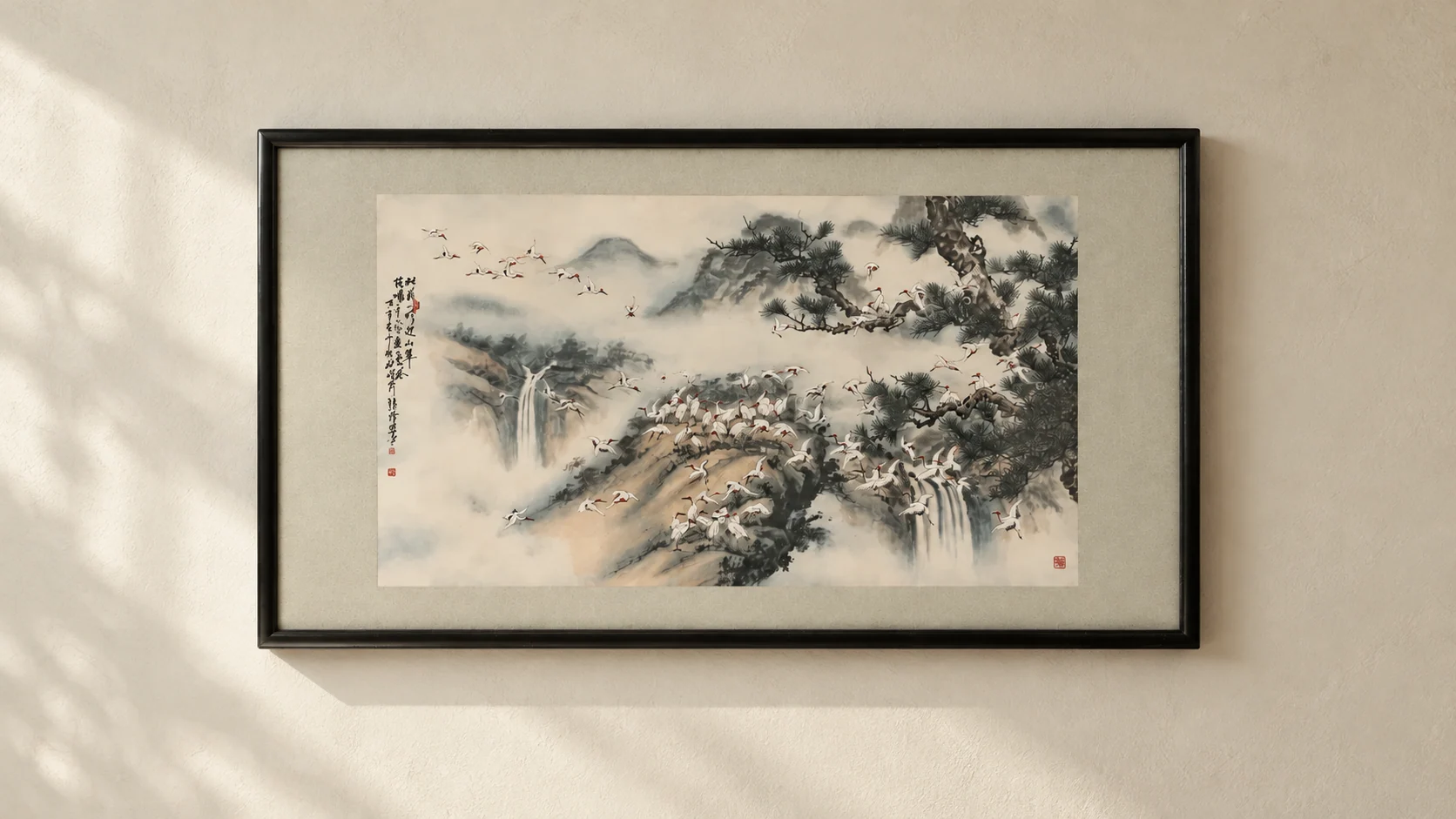
Ink painting is done in ink on paper or silk, and every shade from deep black to the palest grey comes from how much water is in the brush. Some paintings use ink alone; others add a few touches of soft color.
Hang it at eye level
On an empty wall, the center of the painting should be at standing eye level, about 1.45 to 1.55 m from the floor. Above a settee or console, leave about 20 to 30 cm between the bottom of the frame and the top of the backrest or table, so the painting and the furniture read as one group. A long horizontal painting suits a settee, and about two-thirds of the settee’s width looks balanced.
Soft light, dry wall
Direct sun over time yellows the paper, and the pale touches of color fade first. Hang the painting on a wall the sun doesn’t reach, away from damp walls or walls shared with a bathroom. If you want to light it, use a warm lamp angled down from above, so there is no glare on the glass when you stand in front of it.
Slim frame, wide mount
With so much empty space, an ink painting suits a slim frame in dark or deep-toned wood; it doesn’t need ornate carving. A mount of ivory or pale grey paper or fabric around the picture gives it room to breathe and makes it look larger. If there is glass, keep a small gap between the glass and the painting rather than pressing them together, especially in the humid season.
What to look at
Start with the brushwork: dark and pale, dry and broken, wet and spreading, each stroke shows whether the hand moved fast or slow. Then the empty space: clouds, mist and water are often just bare paper, and that emptiness is what makes the mountains and trees stand out. Last come the inscription and the red seals, usually tucked into a corner. You don’t need to read them; just notice where they sit and how they balance the picture.
— Kho Đồ Cổ